Loading research intelligence
Preparing the structured Flagship evidence library.
Loading research intelligence
Preparing the structured Flagship evidence library.
Five weight-management studies of semaglutide, tirzepatide and retatrutide already evaluated in the WPF Flagship set. Not a systematic or complete review of these agents.
Changelog: Added how SURMOUNT-5 and the retatrutide phase 2 trial handled treatment discontinuation, from the analysis plans and the registry participant flow, with the unverified remainder stated; added two re-runnable participant-flow checks; rechecked the observational cohort against the open-access full text and re-ran all automated checks.
results.json · results.csv · results.bib · SHA256SUMS · LICENSE-NOTICE.txt · API: /api/research/flagship/weight-management?version=1.4.0&resultId=…
Earlier versions stay published unchanged: 1.0.0 release.json · 1.0.0 SHA256SUMS1.1.0 release.json · 1.1.0 SHA256SUMS1.2.0 release.json · 1.2.0 SHA256SUMS1.3.0 release.json · 1.3.0 SHA256SUMS. A citation that names a version resolves to that version.
Release history and clarifications
RELEASE-HISTORY.json · Release notes for 1.4.0
What changed in 1.4.0, and why
License: WPF-owned material in this dataset is licensed under Creative Commons Attribution 4.0 International (CC-BY-4.0). See LICENSE-NOTICE.txt.
Covered
Not covered
Ownership unclear, left outside the license
Suggested attribution
World Peptide Foundation, "WPF Flagship Weight Management", version 1.4.0 (2026-11-14), https://www.worldpeptidefoundation.org/releases/wpf-flagship-weight-management/1.4.0/release.json. Licensed under CC BY 4.0 (https://creativecommons.org/licenses/by/4.0/). Please indicate whether you made changes.
Three separate layers. Source verification compares each displayed number with a named place in a primary source. Automated checks are computations WPF ran. Human review: none is recorded for any entry on this page.
Tirzepatide vs semaglutide · Direct head-to-head randomized trial · surmount-5-weight-72w
One change to this record since it was first published. Older versions still resolve.
· Source attribution corrected · Verdict unchanged
SURMOUNT-5 confidence intervals: arm intervals come from the abstract, the between-group interval from the registry
The correction changed source attribution only. Every estimate and every verdict stayed the same. The intervals were already correct; the records now say that the arm intervals come from the publication abstract and the between-group interval from the registry results, so a reader who goes to either source finds the figure where WPF says it is.
Read this change and its sources · Earlier record (version 1.4.0) · Updated record (version 1.5.0) · Correction Log entry
AI-assisted source verification. Documented human review: none recorded.
Original source: PMID 40353578 · DOI 10.1056/NEJMoa2416394 · NCT05822830 · WPF evaluation
Direct head-to-head randomized trial. Participants in one trial were randomly assigned to tirzepatide or semaglutide, so the difference between the two arms is a direct randomized comparison.
Design: SURMOUNT-5 (phase 3b, open-label). Time point: 72 weeks. Estimate: -20.2% with tirzepatide vs -13.7% with semaglutide (least-squares means; P<0.001). Uncertainty: 95% CI -21.4 to -19.1 (tirzepatide); -14.9 to -12.6 (semaglutide)
Compared by scripted retrieval on 2026-11-14. Each locator is written out so you can find it even if a link fails.
-20.2% with tirzepatide and -13.7% with semaglutide at week 72
ClinicalTrials.gov results. Record NCT05822830, Results tab, primary outcome measure 1 (percent change in body weight, baseline to week 72): the tirzepatide arm posts -20.2 and the semaglutide arm posts -13.7, as least-squares means.
Status: Matched: what this page states is found at this location
How read: re-runnable script (check ctgov-surmount5-arms)
The registry posts standard errors, not the confidence intervals shown on this page.
Third-party text, outside WPF’s license: “Percent Change From Baseline in Body Weight”
https://clinicaltrials.gov/study/NCT05822830?tab=results#outcome-measures
95% confidence intervals -21.4 to -19.1 and -14.9 to -12.6; P<0.001
PubMed abstract. Abstract, Results paragraph: reports the week-72 least-squares mean change as -20.2% (95% CI -21.4 to -19.1) for tirzepatide and -13.7% (95% CI -14.9 to -12.6) for semaglutide, P<0.001, among 751 randomized participants.
Status: Matched: what this page states is found at this location
How read: re-runnable script (check pubmed-surmount5)
Primary estimand and the method that produces the displayed values
Statistical analysis plan. SAP version 3 (approved 23 Oct 2024): section 1.1 defines the primary estimand and section 4.3.1 specifies the primary analysis.
Status: Matched: what this page states is found at this location
How read: document read by WPF's automated pipeline, not scripted
The abstract does not name the estimand. The displayed values match the registry's ANCOVA result over the full analysis set, which is the method the plan specifies for its primary (modified treatment-regimen) estimand, so the match is by method, not by an explicit label.
https://cdn.clinicaltrials.gov/large-docs/30/NCT05822830/SAP_001.pdf
Study completion by arm, which is how the registry reports leaving the study
ClinicalTrials.gov results. Record NCT05822830, Results tab, participant flow, overall study period: 375 participants started on tirzepatide and 376 on semaglutide, and 319 in each arm completed the study (56 and 57 did not). Recorded reasons for not completing, tirzepatide then semaglutide: withdrawal by subject 27 and 26, lost to follow-up 16 and 18, adverse event 6 and 6, assigned treatment by mistake 5 and 3, pregnancy 1 and 2, non-compliance with study drug 1 and 1, out of the country 0 and 1. This counts leaving the study. It is not a count of stopping the study drug while staying in the study, which the registry does not post.
Status: Matched: what this page states is found at this location
How read: re-runnable script (check ctgov-surmount5-flow)
Table or figure in the published paper that shows the displayed numbers
Publisher page. Publisher article page reached through the DOI 10.1056/NEJMoa2416394
Status: Not read: WPF could not read this source, so nothing is claimed from it
How read: document read by WPF's automated pipeline, not scripted
An automated request to this address returned HTTP 403 on 2026-11-12, which shows the request was blocked; it does not show why. Europe PMC lists no open-access full text for this paper, and WPF has not established whether the article sits behind a paywall. No table or figure number is claimed.
None recorded.
SURMOUNT-5 (phase 3b, open-label). Tirzepatide vs semaglutide. Primary source: https://doi.org/10.1056/NEJMoa2416394 (PMID 40353578; NCT05822830). Cited from World Peptide Foundation, WPF Flagship Weight Management, version 1.4.0, result surmount-5-weight-72w.
Versioned record:
https://www.worldpeptidefoundation.org/api/research/flagship/weight-management?version=1.4.0&resultId=surmount-5-weight-72w
Release 1.4.0. Versioned record: https://www.worldpeptidefoundation.org/api/research/flagship/weight-management?version=1.4.0&resultId=surmount-5-weight-72w. Earlier versions of this result remain available by changing the version in that address.
Semaglutide 2.4 mg vs placebo, plus lifestyle intervention · Separate placebo-controlled trial (not a head-to-head) · step-1-weight-68w
Original source: PMID 33567185 · DOI 10.1056/NEJMoa2032183 · NCT03548935 · WPF evaluation
Separate placebo-controlled trial (not a head-to-head). This drug was compared with placebo in its own trial. Setting two trials side by side is an indirect comparison across different populations, durations and designs, so their percentages cannot be subtracted.
Design: STEP 1 (double-blind). Time point: 68 weeks. Estimate: -14.9% with semaglutide vs -2.4% with placebo; estimated difference -12.4 percentage points. Uncertainty: Difference 95% CI -13.4 to -11.5
Compared by scripted retrieval on 2026-11-12. Each locator is written out so you can find it even if a link fails.
Mean change -14.9% (semaglutide) vs -2.4% (placebo); difference -12.4 percentage points (95% CI -13.4 to -11.5)
PubMed abstract. Abstract, Results paragraph: reports the week-68 mean change for each arm, the estimated treatment difference with its 95% confidence interval, and P<0.001, among 1,961 randomized adults; the Methods sentence states that the primary estimand assessed effects regardless of treatment discontinuation or rescue interventions.
Status: Matched: what this page states is found at this location
How read: re-runnable script (check pubmed-step1)
Between-group treatment difference -12.4 and its 95% confidence interval -13.4 to -11.5
ClinicalTrials.gov results. Record NCT03548935, Results tab, primary outcome measure 1 (change in body weight, percent, baseline to week 68), analysis row for the semaglutide 2.4 mg vs placebo comparison whose group description names the treatment policy estimand: ANCOVA treatment difference -12.44, two-sided 95% CI -13.37 to -11.51, P<.0001.
Status: Matched: what this page states is found at this location
How read: re-runnable script (check ctgov-step1-difference)
Rounding to one decimal place (halves away from zero) turns the registry values into the displayed ones: -12.44 becomes -12.4, -13.37 becomes -13.4 and -11.51 becomes -11.5. The registry names this row by its estimand (treatment policy), not by an observation period. A second row (hypothetical estimand: -14.42, CI -15.29 to -13.55) exists and is not displayed.
Third-party text, outside WPF’s license: “Change in Body Weight (%)” “Treatment policy estimand”
https://clinicaltrials.gov/study/NCT03548935?tab=results#outcome-measures
Arm values: the paper's modelled -14.9% and -2.4% are not the registry's observed means
ClinicalTrials.gov results. Same outcome measure, results by observation period: the in-trial period posts -15.6 (semaglutide) and -2.8 (placebo); the on-treatment period posts -16.9 and -3.1. These are observed means with standard deviations.
Status: Different value: this location reports another number for the same measure
How read: re-runnable script (check ctgov-step1-arm-means)
The displayed -14.9% and -2.4% are the paper's modelled estimates and are verified in the abstract only. The registry does not say which observation-period figures belong to which analysis row, so pairing in-trial with the treatment policy row would be inferred, and WPF does not rely on that pairing.
Third-party text, outside WPF’s license: “In-trial observation period” “On-treatment observation period”
https://clinicaltrials.gov/study/NCT03548935?tab=results#outcome-measures
Primary estimand: effects regardless of treatment discontinuation or rescue interventions
Statistical analysis plan. Redacted SAP (document dated 3 Jul 2020): section 1.1.4 on estimands defines the primary estimand as a treatment policy estimand (regardless of adherence and of other anti-obesity therapy); section 2.3.1 on the primary endpoint describes the ANCOVA with multiple imputation from retrieved participants.
Status: Matched: what this page states is found at this location
How read: document read by WPF's automated pipeline, not scripted
Section numbering inside this redacted SAP is irregular: the estimand subsections are numbered 1.1.1.3 and 1.1.1.4 under 1.1.4.
https://cdn.clinicaltrials.gov/large-docs/35/NCT03548935/SAP_003.pdf
Table or figure in the published paper that shows the displayed numbers
Publisher page. Publisher article page reached through the DOI 10.1056/NEJMoa2032183
Status: Not read: WPF could not read this source, so nothing is claimed from it
How read: document read by WPF's automated pipeline, not scripted
An automated request to this address returned HTTP 403 on 2026-11-12, which shows the request was blocked; it does not show why. Europe PMC lists no open-access full text for this paper, and WPF has not established whether the article sits behind a paywall. No table or figure number is claimed.
None recorded.
STEP 1 (double-blind). Semaglutide 2.4 mg vs placebo, plus lifestyle intervention. Primary source: https://doi.org/10.1056/NEJMoa2032183 (PMID 33567185; NCT03548935). Cited from World Peptide Foundation, WPF Flagship Weight Management, version 1.4.0, result step-1-weight-68w.
Page:
https://www.worldpeptidefoundation.org/research/flagship/compare/weight-management#step-1-weight-68w
Versioned record:
https://www.worldpeptidefoundation.org/api/research/flagship/weight-management?version=1.4.0&resultId=step-1-weight-68w
Release 1.4.0. Versioned record: https://www.worldpeptidefoundation.org/api/research/flagship/weight-management?version=1.4.0&resultId=step-1-weight-68w. Earlier versions of this result remain available by changing the version in that address.
Tirzepatide 5, 10 or 15 mg vs placebo · Separate placebo-controlled trial (not a head-to-head) · surmount-1-weight-72w
Original source: PMID 35658024 · DOI 10.1056/NEJMoa2206038 · NCT04184622 · WPF evaluation
Separate placebo-controlled trial (not a head-to-head). This drug was compared with placebo in its own trial. Setting two trials side by side is an indirect comparison across different populations, durations and designs, so their percentages cannot be subtracted.
Design: SURMOUNT-1 (phase 3, double-blind). Time point: 72 weeks. Estimate: -15.0%, -19.5% and -20.9% with 5, 10 and 15 mg vs -3.1% with placebo. Uncertainty: 95% CI -15.9 to -14.2, -20.4 to -18.5, -21.8 to -19.9; placebo -4.3 to -1.9
Compared by scripted retrieval on 2026-11-12. Each locator is written out so you can find it even if a link fails.
-15.0%, -19.5% and -20.9% (5, 10, 15 mg) vs -3.1% (placebo) at week 72, with confidence intervals
PubMed abstract. Abstract, Results paragraph: reports the week-72 mean percentage change for each tirzepatide dose and placebo with 95% confidence intervals, among 2,539 randomized adults; the Methods sentence names the treatment-regimen estimand, regardless of treatment discontinuation, in the intention-to-treat population.
Status: Matched: what this page states is found at this location
How read: re-runnable script (check pubmed-surmount1)
The same values, printed on a reproduction of the paper's figure
Public reproduction (corroboration only) (corroboration, not a primary source). ASN Nutrition 2025 conference slides (Gulati), PDF page 22 of 33: reproduces a figure from the NEJM paper. Panel A, whose printed title is overall percent change in body weight from baseline (treatment-regimen estimand), shows -15.0, -19.5 and -20.9 for tirzepatide 5, 10 and 15 mg and -3.1 for placebo. Panel C, with the same estimand label, shows weight-reduction targets.
Status: Matched: what this page states is found at this location
How read: document read by WPF's automated pipeline, not scripted
Corroboration only: a third-party slide, not the paper and not a primary source. WPF read the rendered slide image directly (there is no machine-readable text layer), so this is not scripted. The slide shows no figure number, so the figure number in the original paper is unverified.
Third-party text, outside WPF’s license: “Overall Percent Change in Body Weight from Baseline (treatment-regimen estimand)”
The registry's posted primary result is a different analysis
ClinicalTrials.gov results. Record NCT04184622, Results tab, primary outcome measure 1 (percent change in body weight, primary treatment period, week 72): posts -16.0 (5 mg), -21.4 (10 mg), -22.5 (15 mg) and -2.4 (placebo).
Status: Different value: this location reports another number for the same measure
How read: re-runnable script (check ctgov-surmount1-registry)
These are not the displayed values and cannot verify them. The registry's own population description says data after study drug was stopped are excluded, so this is an efficacy-style analysis, while the displayed values come from the paper's treatment-regimen analysis, which includes data regardless of discontinuation. The two analyses answer different questions, so a difference between them is expected.
Third-party text, outside WPF’s license: “Percent Change From Baseline in Body Weight (Primary Treatment Period)”
https://clinicaltrials.gov/study/NCT04184622?tab=results#outcome-measures
Which estimand each set of numbers belongs to
Statistical analysis plan. SAP version 2 (28 Sep 2021): section 6.2 introduces two estimands, efficacy and hybrid; the opening of section 6.13 says which guides which purpose; section 6.13.1.1 specifies the efficacy-estimand analysis (mixed model, efficacy analysis set); section 6.13.1.2 specifies the hybrid-estimand analysis (ANCOVA with multiple imputation, full analysis set, regardless of adherence).
Status: Matched: what this page states is found at this location
How read: document read by WPF's automated pipeline, not scripted
The abstract's treatment-regimen estimand corresponds in content to the plan's hybrid estimand; the plan does not use the label treatment-regimen. The plan also says publications would be guided by the efficacy estimand, and the protocol assigns the efficacy estimand to all purposes other than the FDA submission, yet the abstract headlines the treatment-regimen values. The audit of 2026-11-12 found no accessible primary source that resolves this, so it stays an open question.
https://cdn.clinicaltrials.gov/large-docs/22/NCT04184622/SAP_001.pdf
Which analysis the protocol assigns to which purpose
Study protocol. Protocol amendment b (approved 4 Oct 2021), section 9.4.3.1 on primary analyses: defines the efficacy and hybrid estimands; the primary efficacy analysis for the FDA is guided by the hybrid estimand (full analysis set, ANCOVA with multiple imputation) and, for all other purposes, by the efficacy estimand (efficacy analysis set, mixed model). Section 10.1.10 leaves the publication policy to the Clinical Trial Agreement.
Status: Matched: what this page states is found at this location
How read: document read by WPF's automated pipeline, not scripted
Agrees with the analysis plan on the two estimands. The protocol does not mention publications by name; only the analysis plan does. Neither document explains why the paper headlines the treatment-regimen values, which correspond to the hybrid estimand.
https://cdn.clinicaltrials.gov/large-docs/22/NCT04184622/Prot_000.pdf
Table or figure in the published paper that shows the displayed numbers
Publisher page. Publisher article page reached through the DOI 10.1056/NEJMoa2206038
Status: Not read: WPF could not read this source, so nothing is claimed from it
How read: document read by WPF's automated pipeline, not scripted
An automated request to this address returned HTTP 403 on 2026-11-12, which shows the request was blocked; it does not show why. Europe PMC lists no open-access full text for this paper, and WPF has not established whether the article sits behind a paywall. No table or figure number is claimed.
None recorded.
SURMOUNT-1 (phase 3, double-blind). Tirzepatide 5, 10 or 15 mg vs placebo. Primary source: https://doi.org/10.1056/NEJMoa2206038 (PMID 35658024; NCT04184622). Cited from World Peptide Foundation, WPF Flagship Weight Management, version 1.4.0, result surmount-1-weight-72w.
Versioned record:
https://www.worldpeptidefoundation.org/api/research/flagship/weight-management?version=1.4.0&resultId=surmount-1-weight-72w
Release 1.4.0. Versioned record: https://www.worldpeptidefoundation.org/api/research/flagship/weight-management?version=1.4.0&resultId=surmount-1-weight-72w. Earlier versions of this result remain available by changing the version in that address.
Retatrutide 1, 4, 8 or 12 mg vs placebo · Separate placebo-controlled trial (not a head-to-head) · retatrutide-phase2-weight-48w
Original source: PMID 37366315 · DOI 10.1056/NEJMoa2301972 · NCT04881760 · WPF evaluation
Separate placebo-controlled trial (not a head-to-head). This drug was compared with placebo in its own trial. Setting two trials side by side is an indirect comparison across different populations, durations and designs, so their percentages cannot be subtracted.
Design: Retatrutide phase 2 (double-blind). Time point: 48 weeks (primary endpoint at 24 weeks). Estimate: At 48 weeks: -8.7% (1 mg), -17.1% (4 mg), -22.8% (8 mg), -24.2% (12 mg) vs -2.1% placebo. Uncertainty: Not reported in the abstract. ClinicalTrials.gov posts differences from placebo at week 48 (95% CI): 1 mg -6.57 (-8.94 to -4.20); 12 mg -22.11 (-24.92 to -19.31). The 4 mg and 8 mg groups are posted separately by starting dose.
Compared by scripted retrieval on 2026-11-14. Each locator is written out so you can find it even if a link fails.
48-week least-squares mean change: -8.7% (1 mg), -17.1% (4 mg), -22.8% (8 mg), -24.2% (12 mg) vs -2.1% (placebo)
PubMed abstract. Abstract, Results paragraph: reports the 48-week least-squares mean percentage change for the 1 mg group, the combined 4 mg group, the combined 8 mg group, the 12 mg group and placebo, among 338 enrolled adults.
Status: Matched: what this page states is found at this location
How read: re-runnable script (check pubmed-retatrutide)
The same 48-week values in the registry
ClinicalTrials.gov results. Record NCT04881760, Results tab, first secondary outcome measure for mean percent change in body weight at week 48: placebo -2.11, 1 mg -8.67 and 12 mg -24.22; the 4 mg and 8 mg groups are posted as separate starting-dose arms (-16.32 and -17.83; -21.72 and -23.88).
Status: Matched: what this page states is found at this location
How read: re-runnable script (check ctgov-retatrutide-w48)
The primary outcome (week 24) is outcome measure 1 in the registry; the week-48 measure is the first secondary.
Third-party text, outside WPF’s license: “Mean Percent Change From Baseline in Body Weight”
https://clinicaltrials.gov/study/NCT04881760?tab=results#outcome-measures
Uncertainty shown on this page: differences from placebo with 95% confidence intervals
ClinicalTrials.gov results. Same outcome measure, statistical analyses: the 1 mg arm vs placebo posts a least-squares mean difference of -6.57 (95% CI -8.94 to -4.20); the 12 mg arm vs placebo posts -22.11 (95% CI -24.92 to -19.31).
Status: Matched: what this page states is found at this location
How read: re-runnable script (check ctgov-retatrutide-diff-1mg)
These are differences from placebo, not confidence intervals around each arm's own mean. A second check covers the 12 mg row.
https://clinicaltrials.gov/study/NCT04881760?tab=results#outcome-measures
Primary estimand (efficacy; hypothetical strategy for permanent discontinuation) applies to the 48-week estimate
Statistical analysis plan. SAP version 4.0 (15 Dec 2022): section 1.1 defines the primary estimand and the estimands for secondary objectives; section 4.3.2 describes the main analytical approach.
Status: Matched: what this page states is found at this location
How read: document read by WPF's automated pipeline, not scripted
The registry population excludes data after discontinuation of study drug, consistent with the hypothetical strategy.
https://cdn.clinicaltrials.gov/large-docs/60/NCT04881760/SAP_001.pdf
Study completion by starting arm, which is how the registry reports leaving the study
ClinicalTrials.gov results. Record NCT04881760, Results tab, participant flow, overall study period: 338 participants started across seven starting arms. Completed the study out of started: placebo 50 of 70, 1 mg 60 of 69, 4 mg 26 of 33 and 26 of 34 (52 of 67), 8 mg 30 of 35 and 29 of 35 (59 of 70), 12 mg 54 of 62. In the placebo arm 13 of the 20 who did not complete withdrew by their own choice. This counts leaving the study. It is not a count of stopping the study drug while staying in the study, which the registry does not post.
Status: Matched: what this page states is found at this location
How read: re-runnable script (check ctgov-retatrutide-flow)
Table or figure in the published paper that shows the displayed numbers
Publisher page. Publisher article page reached through the DOI 10.1056/NEJMoa2301972
Status: Not read: WPF could not read this source, so nothing is claimed from it
How read: document read by WPF's automated pipeline, not scripted
An automated request to this address returned HTTP 403 on 2026-11-12, which shows the request was blocked; it does not show why. Europe PMC lists no open-access full text for this paper, and WPF has not established whether the article sits behind a paywall. No table or figure number is claimed.
None recorded.
Retatrutide phase 2 (double-blind). Retatrutide 1, 4, 8 or 12 mg vs placebo. Primary source: https://doi.org/10.1056/NEJMoa2301972 (PMID 37366315; NCT04881760). Cited from World Peptide Foundation, WPF Flagship Weight Management, version 1.4.0, result retatrutide-phase2-weight-48w.
Versioned record:
https://www.worldpeptidefoundation.org/api/research/flagship/weight-management?version=1.4.0&resultId=retatrutide-phase2-weight-48w
Release 1.4.0. Versioned record: https://www.worldpeptidefoundation.org/api/research/flagship/weight-management?version=1.4.0&resultId=retatrutide-phase2-weight-48w. Earlier versions of this result remain available by changing the version in that address.
Tirzepatide vs semaglutide (formulations labeled for type 2 diabetes, on or off label) · Observational cohort (not randomized) · jama-intern-med-2024-realworld
Original source: PMID 38976257 · DOI 10.1001/jamainternmed.2024.2525 · WPF evaluation
Observational cohort (not randomized). Patients were not randomized. People who chose or were prescribed each drug were matched statistically, so differences can reflect factors that were not measured. Results describe time on treatment only.
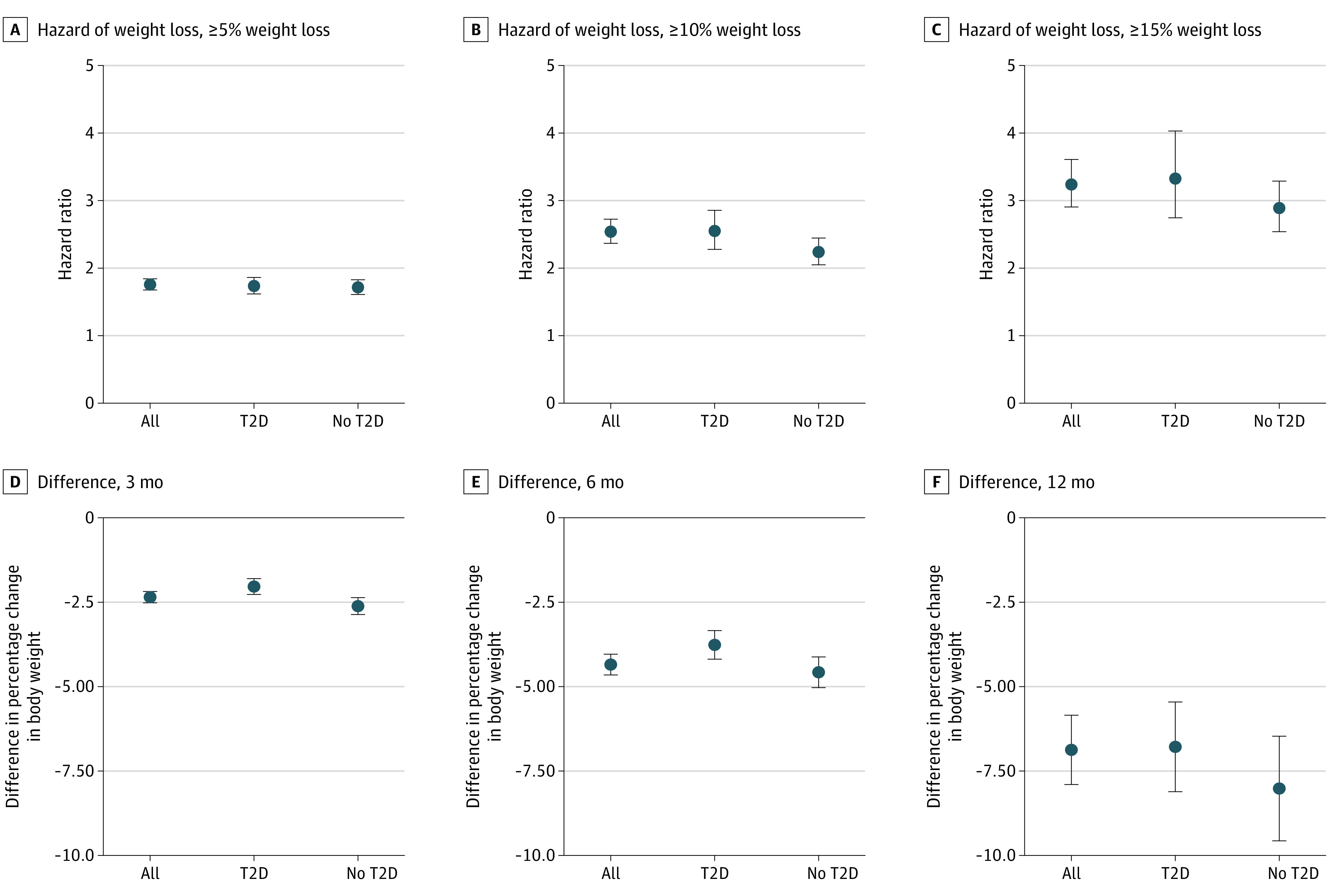
Design: Rodriguez and colleagues, JAMA Internal Medicine 2024: cohort study, not a randomized trial. Time point: Up to 12 months, on-treatment. Estimate: Tirzepatide users were more likely to reach 5%, 10% and 15% weight loss (hazard ratios 1.76, 2.54, 3.24). Uncertainty: Hazard-ratio 95% CIs 1.68-1.84, 2.37-2.73, 2.91-3.61. Weight differences favoring tirzepatide: -2.4% (95% CI -2.5 to -2.2) at 3 months, -4.3% (-4.7 to -4.0) at 6 months, -6.9% (-7.9 to -5.8) at 12 months
Compared by scripted retrieval on 2026-11-14. Each locator is written out so you can find it even if a link fails.
Population: 41,222 adults (32,029 semaglutide; 9,193 tirzepatide); 18,386 after matching; 9,563 (52.0%) with type 2 diabetes
Open-access full text. Results, first paragraph under patient characteristics, and Figure 1 (study flow diagram); matched-cohort characteristics are in the Table.
Status: Matched: what this page states is found at this location
How read: re-runnable script (check pmc-jama-population)
Read in the PubMed Central copy, which Europe PMC lists as open access (CC BY-NC-ND).
Hazard ratios 1.76, 2.54 and 3.24 for reaching 5%, 10% and 15% weight loss, with confidence intervals (exact values)
Open-access full text. Results paragraph on weight-loss thresholds, and the Abstract: the hazard ratios and their 95% confidence intervals are printed in the text.
Status: Matched: what this page states is found at this location
How read: re-runnable script (check pmc-jama-hazard-ratios)
The article body points to Figure 3 after the hazard-ratio sentence, but the Figure 3 caption describes mean changes within each treatment group and Figure 2 shows event probabilities; the Figure 4 caption and image show the hazard ratios, so WPF follows the figure itself.
Hazard ratios, as plotted for the overall matched cohort
Open-access full text. Figure 4, panels A to C. Panel A plots the hazard of 5% or greater weight loss, panel B 10% or greater and panel C 15% or greater, each as tirzepatide vs semaglutide. In every panel the category labelled All is the overall matched cohort, shown beside the T2D and No T2D categories.
Status: Matched: what this page states is found at this location
How read: document read by WPF's automated pipeline, not scripted
Read from the figure image in the PubMed Central open-data copy (file md5 matches the bucket manifest). The figure prints no values, so the All points were read by eye as consistent with 1.76, 2.54 and 3.24; exact values come from the text.
Third-party text, outside WPF’s license: “All” “T2D” “No T2D”
https://pmc.ncbi.nlm.nih.gov/articles/PMC11231910/#ioi240039f4
Adjusted weight differences -2.4%, -4.3% and -6.9% at 3, 6 and 12 months, with confidence intervals (exact values)
Open-access full text. Results paragraph on on-treatment weight change after adjusting for residual confounding, and the Abstract: the differences and their 95% confidence intervals are printed in the text.
Status: Matched: what this page states is found at this location
How read: re-runnable script (check pmc-jama-differences)
The article body cites Figure 3 after this sentence; Figure 3 shows mean changes within each treatment group, not differences. The differences are plotted in Figure 4.
Adjusted differences, as plotted for the overall matched cohort
Open-access full text. Figure 4, panels D to F. Panel D plots the difference in percentage change in body weight at 3 months, panel E at 6 months and panel F at 12 months, tirzepatide vs semaglutide among matched patients still on treatment. In every panel the category labelled All is the overall matched cohort, beside the T2D and No T2D categories.
Status: Matched: what this page states is found at this location
How read: document read by WPF's automated pipeline, not scripted
Read from the same figure image. The figure prints no values, so the All points were read by eye as consistent with -2.4, -4.3 and -6.9; exact values come from the text.
Third-party text, outside WPF’s license: “All” “T2D” “No T2D”
https://pmc.ncbi.nlm.nih.gov/articles/PMC11231910/#ioi240039f4
Follow-up ended by discontinuation for 55.9% (tirzepatide) and 52.5% (semaglutide)
Open-access full text. Results, patient characteristics paragraph (5,140 and 4,823 patients).
Status: Matched: what this page states is found at this location
How read: re-runnable script (check pmc-jama-discontinuation)
Estimand and censoring
Open-access full text. Methods, weight outcomes paragraph: names on-treatment weight loss as the primary estimand of interest, with follow-up censored at the first of treatment discontinuation (30 or more days without medication on hand), switching to a different GLP-1 receptor agonist, last encounter, or study end (3 Nov 2023). Methods, sensitivity analyses: a modified intention-to-treat analysis ignored censoring for discontinuation and switching and used all available follow-up weights.
Status: Matched: what this page states is found at this location
How read: re-runnable script (check pmc-jama-estimand)
The displayed numbers come from the primary on-treatment analysis. The modified intention-to-treat result is in the paper's supplement figures, which WPF did not read; the authors' Discussion says it showed smaller weight reductions with similar differences between the drugs.
The modified intention-to-treat sensitivity analysis
Open-access full text. Supplement 2, sections 2.1.1 and 2.1.2 on sensitivity analyses (eFigures 3 to 6): in the modified intention-to-treat analysis, where only administrative censoring applied, fewer patients reached the 5%, 10% and 15% weight-loss thresholds, weight reductions were smaller at every time point, and treatment effects were described as somewhat attenuated.
Status: Matched: what this page states is found at this location
How read: document read by WPF's automated pipeline, not scripted
Supplement text was read; the plotted eFigure values were not extracted. The Discussion of the paper separately describes the differences between the two drugs as similar under this analysis; the supplement wording is somewhat attenuated, and both are recorded.
https://pmc-oa-opendata.s3.amazonaws.com/PMC11231910.1/jamainternmed-e242525-s002.pdf
The authors' own limitations and disclosures
Open-access full text. Discussion, Strengths and Limitations paragraph; end matter, Conflict of Interest Disclosures and Author Contributions.
Status: Matched: what this page states is found at this location
How read: re-runnable script (check pmc-jama-author-statements)
See the authors' statements below. No funding or role-of-funder statement was found.
Publisher article page
Publisher page. JAMA Network article page for this paper (the PubMed Central copy above was read instead).
Status: Not read: WPF could not read this source, so nothing is claimed from it
How read: document read by WPF's automated pipeline, not scripted
An automated request to this address returned HTTP 403 on 2026-11-12, which shows the request was blocked. WPF read the open-access PubMed Central copy instead and did not compare it line by line with the publisher page.
https://jamanetwork.com/journals/jamainternalmedicine/fullarticle/2821080
Open-access full text (PubMed Central copy), Discussion and end matter, read on 2026-11-12. Paraphrased by WPF.
Limitations
Disclosures
Funding
Not identified. The full text has no funding or role-of-funder statement; the author contributions list who obtained funding but do not name a funder. Affiliations are not treated as the funder.
None recorded.
Rodriguez and colleagues, JAMA Internal Medicine 2024: cohort study, not a randomized trial. Tirzepatide vs semaglutide (formulations labeled for type 2 diabetes, on or off label). Primary source: https://doi.org/10.1001/jamainternmed.2024.2525 (PMID 38976257). Cited from World Peptide Foundation, WPF Flagship Weight Management, version 1.4.0, result jama-intern-med-2024-realworld.
Versioned record:
https://www.worldpeptidefoundation.org/api/research/flagship/weight-management?version=1.4.0&resultId=jama-intern-med-2024-realworld
Release 1.4.0. Versioned record: https://www.worldpeptidefoundation.org/api/research/flagship/weight-management?version=1.4.0&resultId=jama-intern-med-2024-realworld. Earlier versions of this result remain available by changing the version in that address.
Audited release: 1.2.0. Human review: none recorded. Human review is planned and is tracked separately. Nothing on this page is a human review, and no reviewer has completed one.
Record as data: 2026-11-12-ai-assisted-source-verification.json
Scripted pass: 15.9 seconds in total. All five results passed every scripted step: page shows the record, citation reopens the pinned record, checksums match, source claims and 18 source checks pass. Document reads by hand (plans, protocol, supplement, figure image, slides) were not timed individually.
Findings.
Reproduced
Limits
Reproduced
Limits
Reproduced
Limits
Reproduced
Limits
Reproduced
Limits
Two stored fields of the WPF evaluation retatrutide:2 held the wrong sentence from the abstract. They were corrected on 2026-11-11 and the older text was kept, not overwritten.
Field: population (retatrutide:2)
Older record: Its dose-response relationships with respect to side effects, safety, and efficacy for the treatment of obesity are not known.
Current record: 338 adults with a BMI of 30 or higher, or 27 to under 30 plus at least one weight-related condition
Why: PubMed abstract (PMID 37366315) and ClinicalTrials.gov NCT04881760 enrollment (338 actual). The stored value was a background sentence, not a population.
Validation: automated source validation. Human adjudication: none recorded.
Field: interventionComparator (retatrutide:2)
Older record: We conducted a phase 2, double-blind, randomized, placebo-controlled trial involving adults who had a body-mass index (BMI, the weight in kilograms divided by the square of the height in meters) of 30 or higher or who had a BMI of 27 to less than 30 plus at least one weight-related condition.
Current record: Once-weekly subcutaneous retatrutide (1, 4, 8 or 12 mg, with differing starting doses in some arms) vs placebo for 48 weeks
Why: PubMed abstract (PMID 37366315). The stored value was the trial-design sentence, which names no intervention or comparator doses.
Validation: automated source validation. Human adjudication: none recorded.
To recover and follow it: open release.json (or the 1.0.0 file, which carries the same entries) and read fieldCorrections: each entry has previous, corrected and basis. Then open the current result or its WPF evaluation. The earlier release version 1.0.0 was first published after this correction, so it already shows the corrected text; the pre-correction text exists only in the previous field.
This is a different WPF record and does not describe any weight-management result. The Humanin citation for PMID 42223320 was shown as “Observational human evidence” but studies semen from cattle, so its tier was corrected to animal research on 2026-11-10. The earlier public snapshots were left unchanged and a new snapshot records the corrected state. Read the entry on the corrections page; the corrected record is on the Humanin profile.