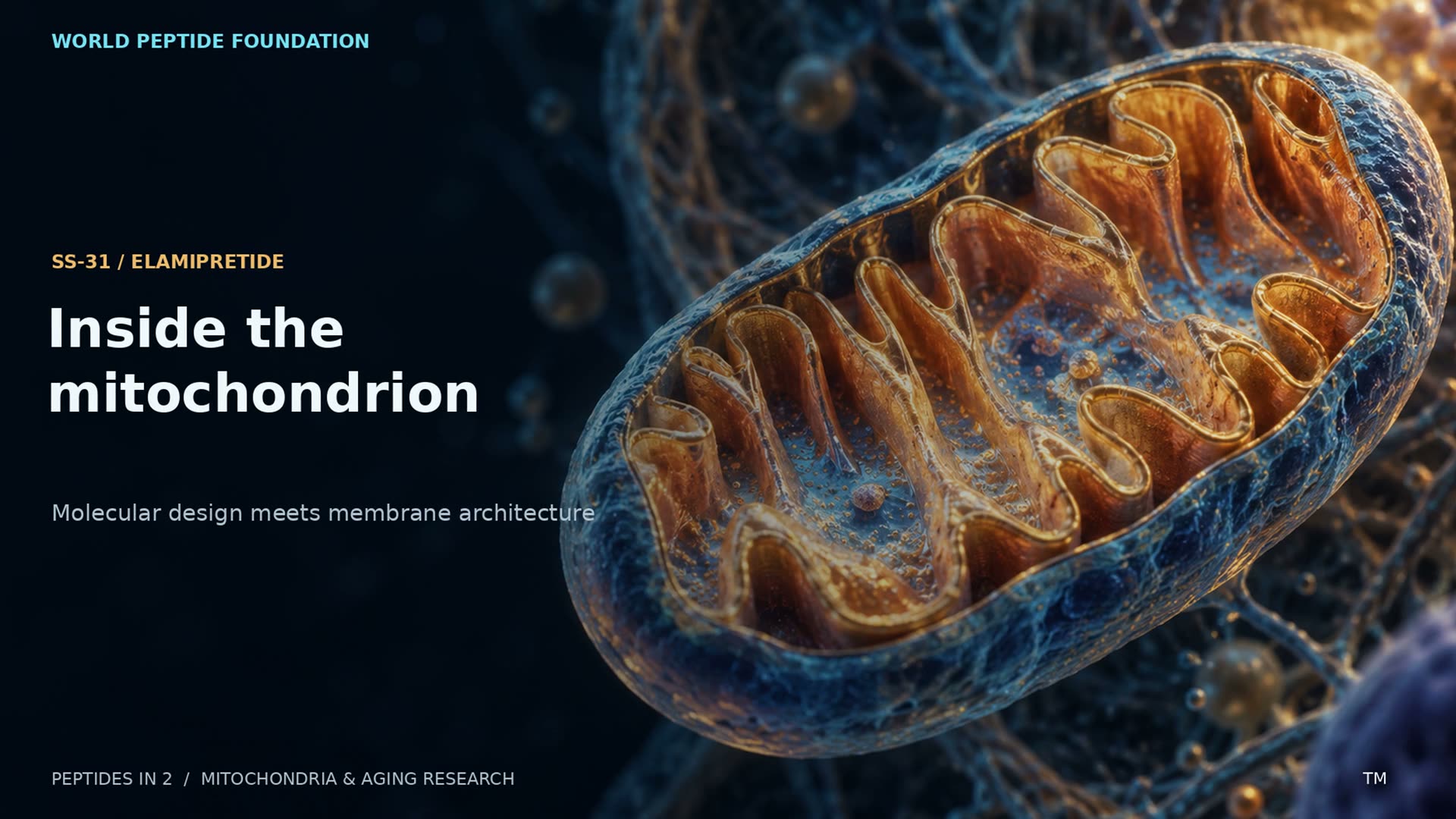
Collection episode 03 · 2:04 · English
Peptides in 2TM · SS-31 (Elamipretide)
SS‑31 (Elamipretide) | What the Mitochondrial Studies Measured
Elamipretide, also known as SS‑31, is a peptide studied for its effects on mitochondria. This film introduces the research behind it and the questions scientists asked about cellular energy. The sources below distinguish a short-term laboratory measurement in older adults from the evidence and U.S. approval for Barth syndrome.
English narration with optional English captions.
Inside the film
Select a time to play from that point.
- Inside the mitochondrion
- The Szeto-Schiller peptides
- Cardiolipin and the inner membrane
- The older-adult study
- Forzinity and Barth syndrome
- What the approval rested on
- What the approval does not cover
What the studies measured
A short-term laboratory measurement in older adults
Roshanravan and colleagues ran a randomized, double-blind, placebo-controlled trial of a single elamipretide infusion in 39 healthy adults aged 60 to 85, enrolled because their muscle mitochondria worked poorly. Using magnetic resonance and optical spectroscopy in a hand muscle, they measured mitochondrial capacity during exercise (ATPmax). Roshanravan et al., PLoS One 2021 (PMID 34264994).
Immediately after the 2-hour infusion, ATPmax was higher than with placebo (change in ATPmax P = 0.055; percentage change P = 0.045). On day 7 there was no difference. There was no significant effect on fatigue resistance, measured as force over repeated contractions. The study was funded by Stealth BioTherapeutics, and three authors had been paid consultants to the company from 2014 to 2016.
That makes it a temporary change in a muscle-energy marker. It did not measure lifespan, healthspan, or any aging outcome.
| Question | Older-adult study (2021) | FDA accelerated approval (2025) |
|---|---|---|
| Who was studied | Older-adult study (2021)39 healthy adults aged 60 to 85 with poorly functioning muscle mitochondria | FDA accelerated approval (2025)Adults and children with Barth syndrome weighing at least 30 kg |
| What was measured | Older-adult study (2021)Mitochondrial capacity in a hand muscle (ATPmax) and fatigue resistance | FDA accelerated approval (2025)Knee extensor muscle strength, an intermediate clinical endpoint |
| What was reported | Older-adult study (2021)Higher ATPmax right after one infusion; no difference at day 7; no change in fatigue resistance | FDA accelerated approval (2025)Strength increases were seen during an open-label extension, not in the randomized period |
| What it does not show | Older-adult study (2021)Longer life, lasting performance benefit, or slowed aging | FDA accelerated approval (2025)Benefit in healthy people, general anti-aging use, or any other product sold as SS‑31 |
The two columns answer different questions and should not be combined into one claim. The Foundation’s claim check on this question reaches the same boundary. Read the elamipretide research profile.
The U.S. approval for Barth syndrome
On September 19, 2025, FDA granted accelerated approval to Forzinity (elamipretide) injection as the first treatment for Barth syndrome, in patients weighing at least 30 kg. FDA announcement.
The prescribing information states the indication: to improve muscle strength in adult and pediatric patients with Barth syndrome weighing at least 30 kg. It is approved under accelerated approval based on an improvement in knee extensor muscle strength, an intermediate clinical endpoint, and continued approval may depend on a confirmatory trial. Forzinity prescribing information (DailyMed).
The randomized, double-blind, placebo-controlled crossover trial enrolled 12 people. Its primary endpoints were distance walked in six minutes and the fatigue score on the Barth syndrome Symptom Assessment, and elamipretide was not superior to placebo on either. Increases in knee extensor strength were not observed in the randomized trial but were observed during the open-label extension.
The most common adverse reactions were injection-site reactions. Serious hypersensitivity reactions, including serious allergic reactions requiring emergency medical intervention, have been reported.
Related films
MOTS‑c follows another peptide connected to mitochondria, from its USC discovery to mouse studies. Watch MOTS‑c
Humanin follows a mitochondrial-derived peptide through cells, worms, mice and human measurements. Watch Humanin
The complete English transcript
SS-31 takes peptide science inside the mitochondrion,
where a membrane's architecture helps cells produce energy.
Also called elamipretide, this four-amino-acid molecule belongs to the Szeto-Schiller family.
Hazel Szeto at Cornell in New York and Peter Schiller in Montreal helped develop the peptides.
A landmark paper appeared in 2004: more than twenty years of published research.
Its partner is cardiolipin, a lipid in the inner mitochondrial membrane.
This membrane folds into cristae, supporting electron transport and production of ATP,
the cell's energy currency.
Laboratory studies found that SS-31 interacts with cardiolipin and supports
mitochondrial energy processes.
A small randomized study in older adults reported improved muscle mitochondrial energy
production after one infusion.
This did not establish longer life or lasting performance benefits.
In September 2025, the FDA granted accelerated approval to Forzinity,
an elamipretide medicine, to improve muscle strength in adults and children with
Barth syndrome weighing at least thirty kilograms.
This rare genetic condition affects mitochondrial function.
Approval drew on knee-extensor strength improvements during an open-label extension.
The randomized trial did not show superiority on its walking and fatigue primary endpoints.
A confirmatory trial is required.
Risks include injection-site reactions and serious allergic reactions.
This specific approval does not cover general anti-aging use or every product sold
as SS-31.
From molecular design to a rare-disease medicine, its story shows why
mitochondrial membranes matter.
World Peptide Foundation.
Peptides in 2.
Every experience matters.
Original sources & further reading
- [1] Zhao K, Zhao GM, Wu D, Soong Y, Birk AV, Schiller PW, Szeto HH. Cell-permeable peptide antioxidants targeted to inner mitochondrial membrane inhibit mitochondrial swelling, oxidative cell death, and reperfusion injury. Journal of Biological Chemistry. 2004;279(33):34682–34690. PMID 15178689.
- [2] Roshanravan B, Liu SZ, Ali AS, et al. In vivo mitochondrial ATP production is improved in older adult skeletal muscle after a single dose of elamipretide in a randomized trial. PLoS One. 2021;16(7):e0253849. PMID 34264994.
- [3] U.S. Food and Drug Administration. FDA Grants Accelerated Approval to First Treatment for Barth Syndrome. News release, September 19, 2025.
- [4] FORZINITY (elamipretide) injection, prescribing information, Stealth BioTherapeutics Inc. DailyMed. Sections 1, 5.2, 6.1 and 14. Checked November 21, 2026.
Source and review status
AI-assisted source verification: on November 21, 2026 the film narration was compared line by line with the PubMed record of the older-adult study, FDA’s September 19, 2025 announcement, the current Forzinity prescribing information (DailyMed), and the Foundation’s claim checks. No conflict with current evidence or approval status was found. The narration says the older-adult study reported improved muscle mitochondrial energy production; in the paper the two reported measures had P values of 0.055 and 0.045. Independent scientific review is pending and no human scientific review is recorded. This film is for education and does not provide medical advice or dosing instructions.
Credits
English captions are available.
Peptides in 2. World Peptide Foundation. Every experience matters.