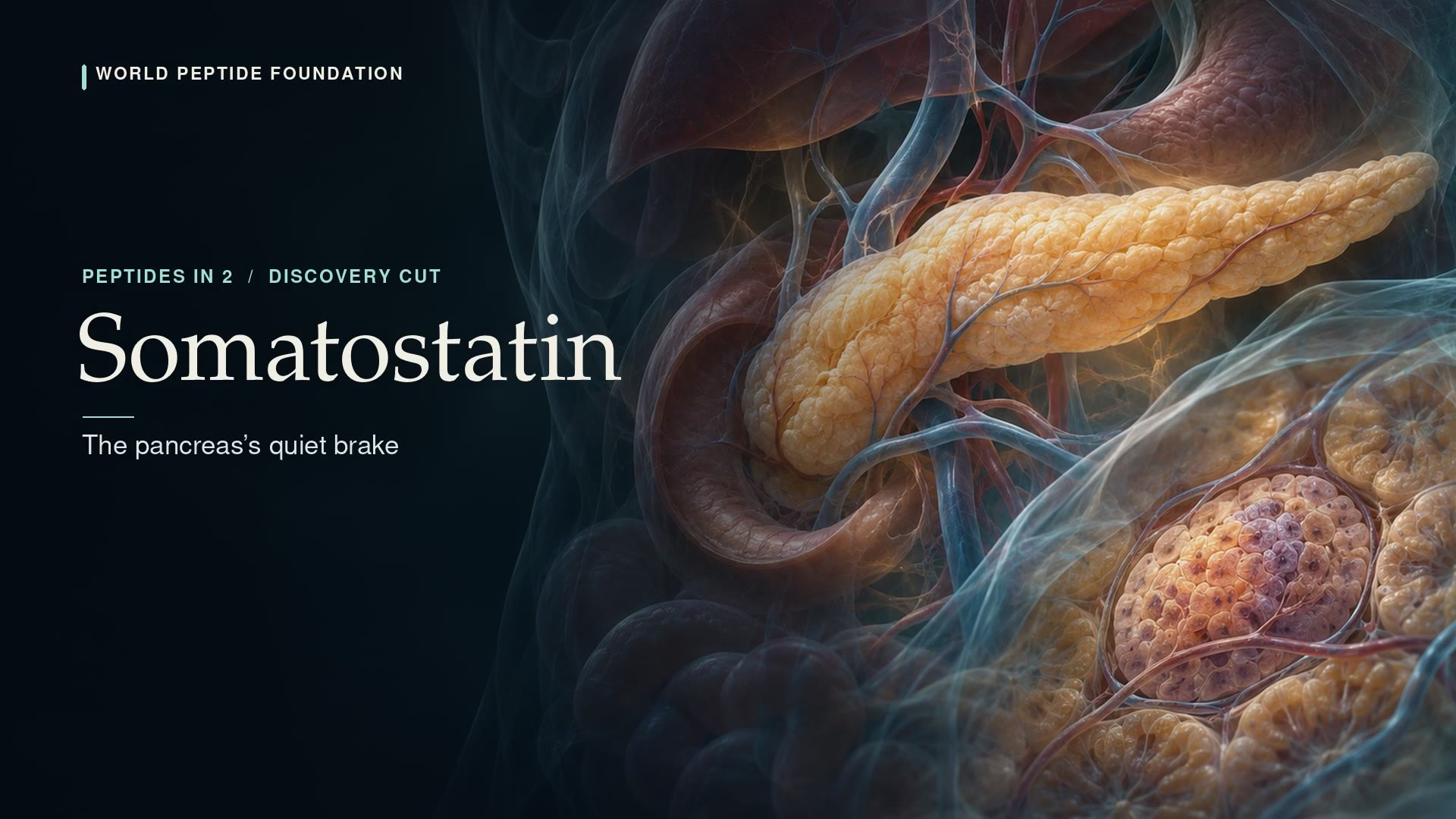
Discovery Cut · 1:52 · English
Peptides in 2TM · Somatostatin
Somatostatin | The Pancreas’s Quiet Brake
Insulin and glucagon help regulate blood sugar. Inside the pancreas, a third peptide hormone helps regulate the cells that release them. Meet somatostatin.
The story starts in La Jolla, California. In January 1973, Paul Brazeau, Wylie Vale, Roger Guillemin, and their colleagues at the Salk Institute reported isolating somatostatin from sheep hypothalamus. It could suppress the release of growth hormone from the pituitary. Inside a pancreatic islet, the same peptide has a different job.
English narration with optional English captions.
Inside the film
Select a time to play from that point.
- The third pancreatic signal
- Meet the alpha, beta, and delta cells
- La Jolla, 1973 and the discovery at Salk
- How somatostatin affects growth hormone release
- How somatostatin acts inside the islet
- Feedback between neighboring cells
What the film follows
From the laboratory to the pituitary
In January 1973, Paul Brazeau, Wylie Vale, Roger Guillemin, and their colleagues at the Salk Institute reported isolating somatostatin from sheep hypothalamus. The peptide could suppress the release of growth hormone from the pituitary. Read the original report
Inside the pancreatic islet
This Discovery Cut follows somatostatin from the 1973 laboratory report into the pancreatic islet. It shows how delta cells communicate with nearby alpha and beta cells, how somatostatin can reduce glucagon and insulin release, and why feedback between neighboring cells matters. Read the islet review
Related films
GHRH follows the signal that stimulates growth hormone release at the pituitary, the release that somatostatin restrains. Watch GHRH
Insulin & Glucagon follows the two hormones that somatostatin helps regulate inside the islet. Watch Insulin & Glucagon
The complete English transcript
Inside the pancreas, two hormones help steer blood sugar.
Insulin helps bring it down.
Glucagon tells the liver to release glucose.
But a third signal can turn both down.
Where does it come from?
Look inside a pancreatic islet.
The alpha cells release glucagon.
The beta cells release insulin.
Nestled among them is a third kind of cell.
It’s called the delta cell.
Its signal is somatostatin.
The story begins far from the pancreas.
La Jolla, California.
In January 1973,
Paul Brazeau, Wylie Vale, Roger Guillemin,
and their colleagues at the Salk Institute
reported isolating a small peptide from sheep hypothalamus.
The team found that it could suppress
the release of growth hormone from the pituitary.
They named it somatostatin.
The discovery started in the brain.
The same peptide turned out to have a different job in the pancreas.
In the islet, somatostatin acts close to where it’s released.
It reaches receptors on nearby alpha and beta cells
and can reduce how much glucagon or insulin they release.
The neighboring cells can also send signals back to the delta cell.
That’s local feedback.
Insulin and glucagon help regulate blood glucose.
Somatostatin helps regulate the cells that release them.
Peptides in 2.
World Peptide Foundation.
Every experience matters.
Original sources & further reading
- [1] Brazeau P, Vale W, Burgus R, Ling N, Butcher M, Rivier J, Guillemin R. Hypothalamic polypeptide that inhibits the secretion of immunoreactive pituitary growth hormone. Science. 1973;179(4068):77–79. PMID 4682131.
- [2] Rorsman P, Huising MO. The somatostatin-secreting pancreatic δ-cell in health and disease. Nature Reviews Endocrinology. 2018. PMC5997567.
Source and review status
AI-assisted source verification: the cited records were checked against their PubMed or publisher records on November 21, 2026. Independent scientific review is pending and no human scientific review is recorded. This film is for education and does not provide medical advice or dosing instructions.
Credits
This educational film uses generated period illustrations, original explanatory graphics and score, and synthetic Tom narration. English captions are available.
Peptides in 2. World Peptide Foundation. Every experience matters.