Discovery Cut · 1:52 · English
Peptides in 2TM · GHRH
GHRH | The Pancreatic Tumor That Revealed a Brain Hormone
A patient develops acromegaly. The pituitary is releasing too much growth hormone, but the signal driving it begins in a tumor of the pancreas. That rare case gave researchers a way to find a signal they had long suspected was in the brain.
In November 1982, two teams reported isolating a growth hormone–releasing peptide from human pancreatic tumors. In 1983, researchers reported two matching forms in the human hypothalamus. The signal had a name: growth hormone–releasing hormone, or GHRH.
English narration with optional English captions.
Inside the film
Select a time to play from that point.
- Acromegaly and a pancreatic tumor
- November 1982: two teams report the peptide
- 1983: the human hypothalamus and a name
- How GHRH and somatostatin shape growth hormone release
- From the brain to the pancreas and back
What the reports found and how the signal works
A tumor as a source
The film opens with a patient who develops acromegaly: over time the hands enlarge and the features of the face change. The pituitary is releasing too much growth hormone. In this rare case, the signal driving that release began in a pancreatic tumor.
Hypothalamic tissue held so little of the signal that it was hard to isolate. The tumors gave researchers another source.
November 1982: two reports
Roger Guillemin’s group published in Science, and Jean Rivier and colleagues published in Nature. Both teams had isolated a peptide from a human pancreatic tumor that could trigger growth hormone release. Guillemin et al., Science (PMID 6812220). Rivier et al., Nature (PMID 6292724).
1983: the human hypothalamus
In 1983, Böhlen and colleagues reported evidence for two forms of the releasing factor in the human hypothalamus that were identical to the two tumor-derived forms, GRF-44-NH₂ and GRF-40. Böhlen et al. (PMID 6412708).
The signal was named growth hormone–releasing hormone: GHRH.
How GHRH and somatostatin act at the pituitary
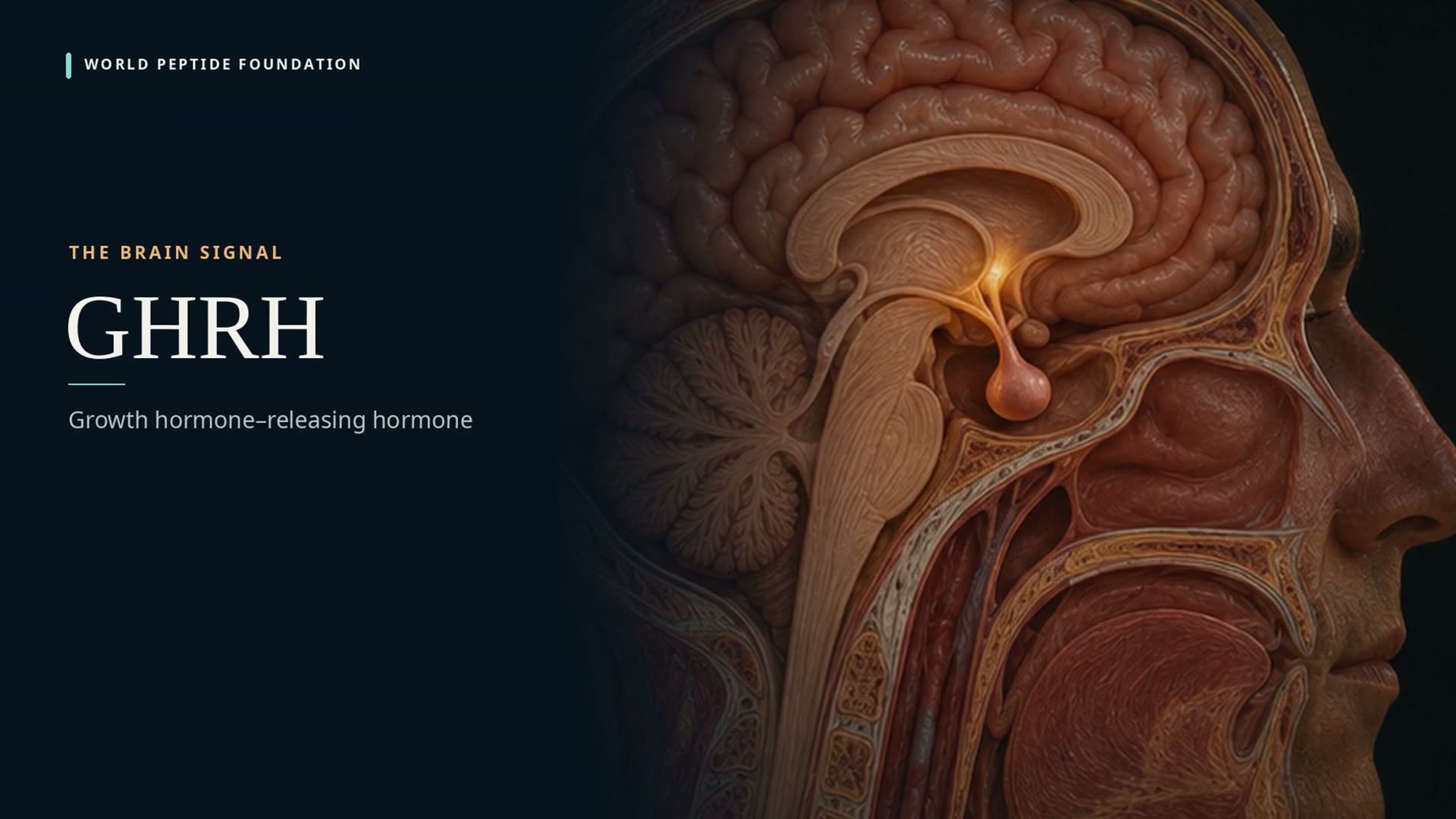
The hypothalamus sends GHRH through small blood vessels to the pituitary, where it stimulates growth hormone release. Somatostatin also reaches the pituitary, where it restrains that release. Together, these signals help shape the pulses of growth hormone in the blood.
| Signal | Where it acts | Effect on growth hormone release |
|---|---|---|
| GHRH | Where it actsReaches the pituitary from the hypothalamus | Effect on growth hormone releaseStimulates release |
| Somatostatin | Where it actsAlso reaches the pituitary | Effect on growth hormone releaseRestrains release |
Somatostatin was first reported from the hypothalamus as an inhibitor of growth hormone release, and later found to act inside the pancreatic islet. Watch Somatostatin
Related films
Sermorelin follows the first 29 amino acids of human GHRH into a diagnostic test and a childhood growth study. Watch Sermorelin
Tesamorelin follows a modified GHRH signal to a CT-based visceral-fat endpoint. Watch Tesamorelin
CJC‑1295 follows the development of a longer-acting GHRH analog. Watch CJC‑1295
The complete English transcript
A patient develops acromegaly.
Over time, the hands enlarge
and the features of the face change.
The pituitary is releasing too much growth hormone.
But the signal driving it begins
in a tumor in the pancreas.
That rare case gave researchers a way to find a signal
they had long suspected was in the brain.
There was so little of it in the hypothalamus
that it was hard to isolate.
The tumors gave them another source.
In November 1982, two teams reported their findings.
Roger Guillemin’s group published in Science.
Jean Rivier and colleagues published in Nature.
Both had isolated a peptide from a human pancreatic tumor
that could trigger growth hormone release.
In 1983, researchers reported
two matching forms in the human hypothalamus.
The signal had a name: growth hormone–releasing hormone.
GHRH.
Here’s how it works.
The hypothalamus sends GHRH
through small blood vessels to the pituitary.
That signal stimulates growth hormone release.
Somatostatin also reaches the pituitary,
where it restrains that release.
Together, these signals help shape the pulses
of growth hormone in the blood.
Somatostatin led us from the brain to the pancreas.
GHRH took us back.
The same signal uncovered in a pancreatic tumor
helps explain the pathway behind our films on
tesamorelin and CJC-1295.
Peptides in 2.
World Peptide Foundation.
Every experience matters.
Original sources & further reading
- [1] Guillemin R, Brazeau P, Böhlen P, Esch F, Ling N, Wehrenberg WB. Growth hormone-releasing factor from a human pancreatic tumor that caused acromegaly. Science. 1982;218(4572):585–587. PMID 6812220.
- [2] Rivier J, Spiess J, Thorner M, Vale W. Characterization of a growth hormone-releasing factor from a human pancreatic islet tumour. Nature. 1982;300(5889):276–278. PMID 6292724.
- [3] Böhlen P, Esch F, Brazeau P, Ling N, Guillemin R. Human hypothalamic growth hormone releasing factor (GRF): evidence for two forms identical to tumor-derived GRF-44-NH2 and GRF-40. Biochemical and Biophysical Research Communications. 1983;114(3):930–936. PMID 6412708.
Source and review status
AI-assisted source verification: the cited records were checked against their PubMed or publisher records on November 21, 2026. Independent scientific review is pending and no human scientific review is recorded. This film is for education and does not provide medical advice or dosing instructions.
Credits
The film uses AI-generated clinical and laboratory reconstructions, original music, and synthetic Tom narration. The acromegaly scene is a case illustration, not a photograph of a patient. English captions are available.
Peptides in 2. World Peptide Foundation. Every experience matters.